

What Is the Difference Between Accounting and Bookkeeping Services?
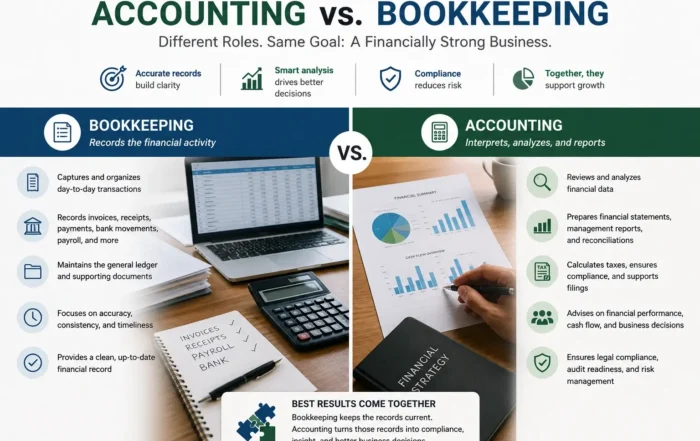
Bookkeeping is the process of capturing and organizing day-to-day financial transactions. That includes recording invoices, receipts, payments, bank movements, payroll entries, supplier bills, and similar operational data. The bookkeeper’s job is to make sure the records are complete, categorized correctly, and updated on time.
Accounting starts where bookkeeping leaves off. Accountants review the recorded data, reconcile it against legal and reporting standards, prepare financial statements, analyze performance, calculate tax liabilities, support filings, and advise on the financial implications of business activity. In a well-run business, bookkeeping creates the raw financial record and accounting turns that record into control, compliance, and usable insight.
That distinction is simple in theory, but in practice the line often overlaps. Many firms provide both services together, especially for SMEs that outsource finance operations. The difference is not whether they touch the same documents. The difference is the level of responsibility and judgment involved.
Bookkeeping Handles the Financial Record
Bookkeeping is transactional by nature. It focuses on accuracy, consistency, and timing. If your company issues invoices, pays suppliers, reimburses expenses, receives bank transfers, runs payroll, or collects customer payments, those transactions need to be entered properly into the accounting system.
A bookkeeper typically manages tasks such as posting purchase and sales invoices, recording cash and bank transactions, matching payments, maintaining the general ledger, and organizing financial documents for later review. In many businesses, bookkeeping also supports accounts payable and accounts receivable follow-up.
This work is essential because accounting cannot function properly without it. If transactions are missing, misclassified, duplicated, or delayed, then every report that follows becomes less reliable. VAT returns, management accounts, and year-end statements all depend on clean underlying records.
For international businesses, bookkeeping also needs to reflect the realities of cross-border trade. That may include multi-currency transactions, intra-EU supplies, reverse-charge treatment, import documentation, and different supporting evidence requirements. Good bookkeeping is not just data entry. It is disciplined financial recordkeeping aligned with the company’s operating model.
Where bookkeeping adds business value
Many business owners underestimate bookkeeping because it sounds administrative. In reality, timely bookkeeping reduces operational friction. It helps you know what has been paid, what is overdue, what cash is available, and whether your documentation will stand up to tax review.
It also creates continuity. If your business is expanding into Bulgaria, using outsourced bookkeeping support can give you a local process for document flow, payroll inputs, invoice handling, and routine reporting without building an in-house department from day one.
Accounting Turns Records Into Compliance and Decisions
Accounting is broader and more analytical. It involves reviewing the books, making adjustments where needed, preparing statutory and management reports, calculating tax exposures, and ensuring the company complies with local accounting rules and filing requirements.
An accountant does not just ask whether a transaction was recorded. The accountant asks whether it was treated correctly, whether supporting evidence is sufficient, whether the transaction has tax implications, and how it affects financial performance and legal reporting.
This is where accounting becomes strategic. Proper accounting helps a business understand margins, liabilities, cash flow patterns, tax positions, payroll burdens, and capital structure. It also supports planning. If you are considering dividend distributions, hiring staff, registering for VAT, expanding to another EU market, or changing your legal structure, accounting input is part of the decision-making process.
What accounting usually includes
In practical terms, accounting services often include account reconciliations, month-end or quarter-end closing, preparation of financial statements, tax calculations, VAT review, payroll accounting, fixed asset treatment, accruals, year-end adjustments, and support during audits or regulatory reviews. Depending on the provider, accounting may also extend into tax advisory, financial planning, and management reporting.
For cross-border companies, accounting becomes even more important because local rules do not operate in isolation. Bulgarian compliance, for example, may intersect with parent-company reporting, EU VAT treatment, transfer pricing considerations, and internal group controls. That is why international businesses usually need more than clean books. They need accounting oversight that connects local execution with broader commercial structure.
The Real Difference Is Responsibility
The clearest way to understand the difference between accounting and bookkeeping services is to look at responsibility.
Bookkeeping is responsible for the integrity of day-to-day records. Accounting is responsible for the integrity of the financial position presented to management, tax authorities, and in many cases statutory institutions.
A bookkeeper records that an invoice exists. An accountant determines how that invoice should be treated for reporting and tax purposes. A bookkeeper may log payroll entries. An accountant checks whether payroll treatment, employer contributions, and reporting obligations align with the law. A bookkeeper tracks bank activity. An accountant reconciles that activity into financial statements and reviews what it means for liquidity and obligations.
That does not mean one role is more valuable than the other. It means they solve different problems. Bookkeeping supports order. Accounting supports control.
Why Businesses Often Need Both
Small companies sometimes try to buy only one of these services, usually to save cost. That can work at a very early stage if transaction volume is low and the owner is closely involved. But once the business has employees, recurring suppliers, VAT exposure, cross-border activity, or investor reporting expectations, separating bookkeeping from accounting too aggressively can create risk.
If you rely only on bookkeeping, you may have organized records but weak financial oversight. If you rely only on periodic accounting without consistent bookkeeping, the accountant spends time fixing basic data issues instead of advising on tax, reporting, and structure.
A combined model is often the most efficient. Bookkeeping keeps the records current. Accounting validates the treatment, prepares the reports, and addresses compliance requirements. For foreign-owned businesses especially, outsourcing both functions to one coordinated provider reduces handoff errors and simplifies communication.
How to Choose the Right Service for Your Business
The right setup depends on your stage, complexity, and risk profile. A freelancer or very small local company may mainly need bookkeeping with light accounting review. An SME with staff, VAT obligations, and regular reporting deadlines usually needs a full accounting function supported by bookkeeping. A foreign investor establishing a Bulgarian entity will often need both from the start, together with payroll, tax coordination, and company administration.
It is also worth checking how the provider defines each service. In the market, the labels are not always consistent. Some firms advertise bookkeeping but include monthly reporting and tax filing support. Others sell accounting packages that still require the client to organize invoices, payroll inputs, and document collection internally.
Ask practical questions. Who records source documents? Who performs reconciliations? Who prepares VAT returns and annual statements? Who communicates with the tax authorities if there is a query? Who monitors deadlines? The answers will tell you whether you are buying basic record maintenance or a broader finance and compliance function.
For companies operating across borders, this matters even more. You do not just need someone to post entries. You need a provider that understands local statutory requirements, tax administration, data confidentiality, and the commercial realities of international operations. That is where a coordinated service model adds real value, and it is why firms such as TaxManagement LLC position accounting and bookkeeping as part of a wider operational support framework rather than isolated tasks.
Accounting vs. Bookkeeping in One Practical Example
Imagine your company sells services to clients in several EU countries, hires local staff in Bulgaria, and pays software subscriptions from foreign vendors. The bookkeeping function records the outgoing and incoming invoices, payroll entries, bank transactions, and expense claims. The accounting function then reviews VAT treatment, checks payroll obligations, prepares monthly reporting, calculates taxes, and ensures the business is filing correctly under local rules.
Without bookkeeping, the accountant has incomplete data. Without accounting, the business may have complete data but still file incorrectly or misunderstand its financial position. That is why the difference between the two is not academic. It affects cost control, compliance exposure, and management confidence.
If you are building or expanding a business, think of bookkeeping as the foundation and accounting as the framework that keeps the structure legally sound and commercially useful. The better those two functions work together, the easier it is to operate with clarity in a regulated market.