


TL;DR:
- Foreign investors in Bulgaria must complete comprehensive legal, financial, and regulatory due diligence before acquiring stakes or deploying capital. They face strict thresholds, mandatory screening, and hefty penalties if they skip or underestimate these checks, ensuring full legal compliance. Thorough verification steps and adherence to EU anti-money laundering standards are essential for a successful market entry.
Foreign investor due diligence in Bulgaria is defined as the comprehensive process of legal, financial, and regulatory verification that non-EU investors must complete before acquiring stakes or deploying capital in the Bulgarian market. Bulgaria’s Investment Promotion Act, the EU FDI Screening Regulation, and the Interinstitutional FDI Screening Council together form the legal backbone of this process. Investors who skip or underestimate these checks face fines, deal delays, and banking complications. This guide covers every critical stage, from initial regulatory thresholds to anti-money laundering compliance, so you can enter the Bulgarian market with confidence and full legal standing.
What are the legal and regulatory requirements for foreign investor due diligence in Bulgaria?
Bulgaria’s FDI screening regime sets clear, mandatory thresholds that every foreign investor must understand before signing any agreement. Non-EU investors acquiring 10% or more of a stake, or committing €2 million or more in sensitive sectors, must apply for prior screening. Sensitive sectors include defense, energy, critical infrastructure, and advanced technology. Missing this threshold triggers automatic penalties.
The Interinstitutional FDI Screening Council conducts the review. The standard review period is 45 days, extendable by 30 days for complex cases, giving a maximum timeline of 75 days. Investors who fail to account for this window in their transaction schedules routinely face deal delays and renegotiated closing dates.
Penalties for non-compliance are significant. Fines reach up to 5% of the investment value, with a minimum of approximately €25,000 for unauthorized foreign direct investment. These are not administrative formalities. They represent real financial exposure for any investor who proceeds without clearance.
The application process runs through the Bulgarian Investment Agency, which forwards submissions to the Interinstitutional Council. Investors must submit detailed transaction and investor disclosures as part of the application. The Inter-Ministerial Council provides additional oversight for deals that touch national security interests.
Key legal requirements at a glance:
- Notification threshold: 10% stake acquisition or €2 million investment in sensitive sectors
- Review body: Interinstitutional FDI Screening Council, coordinated through the Bulgarian Investment Agency
- Timeline: 45-day standard review, extendable to 75 days
- Penalties: Up to 5% of investment value, minimum approximately €25,000
- Automatic screening: Applies to investors with Russian or Belarusian ultimate beneficial owners, regardless of stake size
Pro Tip: Begin your FDI screening application at the letter of intent stage, not after signing. The 45-to-75-day review window must appear in your transaction long-stop date or you risk breach of contract.
How to verify the target Bulgarian company: essential due diligence steps
Company verification in Bulgaria follows a structured sequence. Each step builds on the previous one, and skipping any stage creates gaps that regulators and banks will identify later.
Step 1: Pull a certified extract from the Bulgarian Commercial Register

The Bulgarian Commercial Register, accessible at brra.bg, is the authoritative source for company status, directors, registered capital, and ownership. Certified extracts cost between €3 and €17 and confirm the company’s legal standing. Always request a certified extract, not a simple printout, because courts and regulators require certified versions.
Step 2: Collect the full document package
Standard due diligence documentation includes audited financial statements for at least three years, tax clearance certificates, real estate title deeds, encumbrance certificates, shareholder registers, and board meeting minutes. Each document serves a specific verification purpose. Tax clearance certificates confirm no outstanding liabilities with the National Revenue Agency. Encumbrance certificates confirm that real property is free of mortgages or liens.
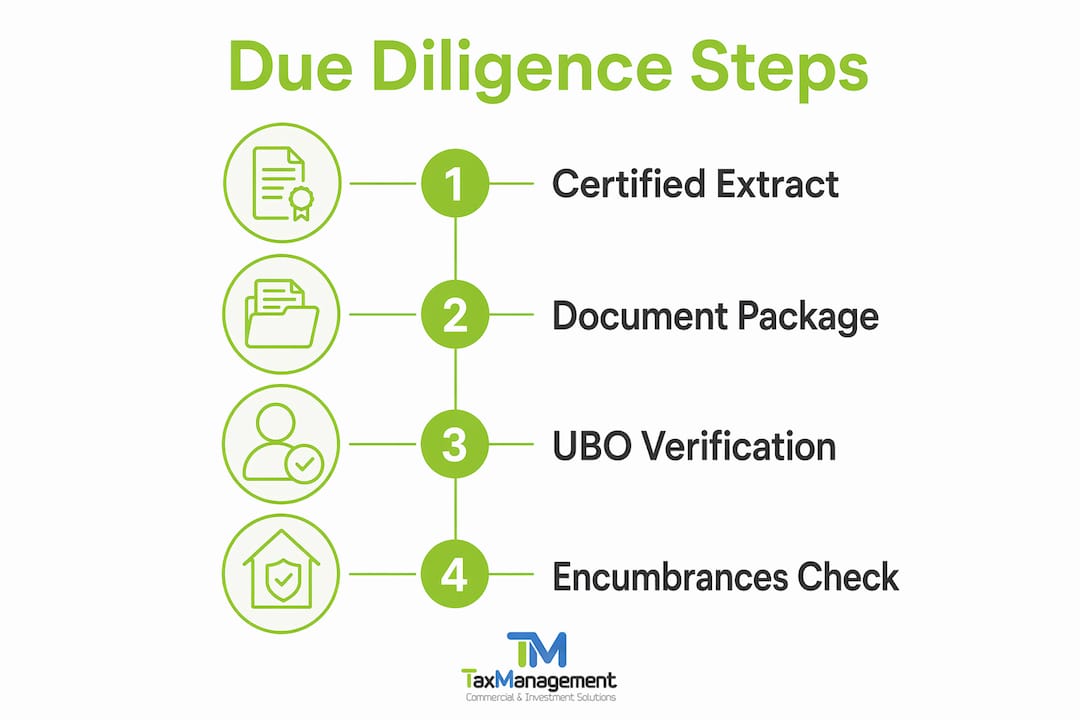
Step 3: Verify the ultimate beneficial owner (UBO)
UBO registration is mandatory under Bulgarian law and EU anti-money laundering directives. Banks and obliged entities perform independent KYC and AML checks and must report any discrepancy between declared UBO information and their own findings within 14 days. If the discrepancy is not corrected within 7 days of notification, fines apply. This means your UBO verification must be thorough and consistent with what the target company has already filed.
Step 4: Check for encumbrances and litigation
Search the Property Register for any mortgages or liens on real assets. Check the court register for pending litigation. These searches are available through official Bulgarian government portals and take one to two business days.
| Document | Source | Purpose |
|---|---|---|
| Certified company extract | Bulgarian Commercial Register (brra.bg) | Confirms legal status and directors |
| Audited financial statements | Target company | Verifies financial health |
| Tax clearance certificate | National Revenue Agency | Confirms no outstanding tax liabilities |
| UBO declaration | Bulgarian Registry Agency | Confirms beneficial ownership chain |
| Encumbrance certificate | Property Register | Confirms real estate is free of liens |
| Board meeting minutes | Target company | Confirms key corporate decisions |
Understanding legal forms of Bulgarian companies also matters during verification, because the liability structure and governance rules differ between an OOD (limited liability company) and an AD (joint-stock company).
How to comply with EU and international due diligence standards in Bulgaria
EU regulatory compliance for foreign investors in Bulgaria operates on two parallel tracks: the EU FDI Screening Regulation and the EU anti-money laundering framework. Both apply simultaneously, and neither excuses non-compliance with the other.
The EU FDI Screening Regulation creates a cooperation mechanism between EU member states. When Bulgaria screens a foreign investment, other member states and the European Commission can submit observations. This means a deal that passes Bulgarian national review can still face scrutiny from Brussels or a neighboring member state if it touches pan-European critical infrastructure.
Bulgaria’s placement on the FATF grey list as of may 2026 adds a second compliance layer. Enhanced due diligence is mandatory under EU Directive 5AMLD and 6AMLD for any transaction involving Bulgarian entities. Enhanced due diligence requires detailed source of funds documentation, senior management approval for the relationship, and ongoing monitoring. International banking partners apply these requirements automatically when they see a Bulgarian counterparty.
Key compliance obligations under EU standards:
- 5AMLD and 6AMLD compliance: Mandatory enhanced due diligence for Bulgarian transactions due to FATF grey list status
- UBO verification: Must align with both Bulgarian registry filings and independent bank KYC findings
- Source of funds documentation: Required by correspondent banks and Bulgarian financial institutions
- FDI screening coordination: EU member states can submit observations during Bulgaria’s national review
- NDA enforceability: Preliminary agreements must be enforceable under Bulgarian jurisdiction to protect shared data during negotiations
“Bulgaria’s FATF grey list designation means that international banks automatically trigger enhanced due diligence protocols for Bulgarian transactions. Investors who prepare detailed source of funds documentation before opening banking discussions save weeks of back-and-forth and reduce the risk of account refusals.”
Cross-border deal structuring also requires attention to how the acquiring entity is organized. Holding structures that route investment through EU jurisdictions can reduce FDI screening exposure, but only if the ultimate beneficial owner is genuinely EU-based. Automatic screening applies to investments where the UBO is Russian or Belarusian, regardless of the intermediate holding structure. Attempting to obscure UBO identity through layered entities triggers both FDI screening and AML violations.
What are common compliance pitfalls for foreign investors in Bulgaria?
The most costly mistakes in Bulgarian investment due diligence are predictable and preventable. Understanding them before you begin saves time, money, and legal exposure.
- Underestimating the FDI screening timeline. Investors who fail to plan for the 45-to-75-day review routinely miss closing deadlines. Build the full 75-day window into every transaction schedule from the letter of intent stage onward.
- Ignoring mandatory notification thresholds. Investors sometimes assume that a 9% stake avoids screening. A subsequent share transfer that crosses 10% triggers retroactive scrutiny and potential fines of up to 5% of the total investment value.
- Overlooking AML documentation requirements. Banks refuse to open accounts or process transactions when source of funds documentation is incomplete. Bulgaria’s FATF grey list status means this documentation must be more detailed than in standard EU jurisdictions.
- Using NDAs that are not enforceable in Bulgaria. An NDA governed solely by English or German law provides limited protection in Bulgarian courts. NDAs must be tailored for Bulgarian jurisdiction to be effective during preliminary negotiations.
- Failing to verify the full UBO chain. Investors who accept a target company’s self-reported ownership structure without independent verification expose themselves to AML liability. Banks will conduct their own checks, and discrepancies create compliance failures.
- Skipping encumbrance and litigation searches. Real estate assets with undisclosed mortgages and companies with pending litigation represent hidden liabilities that standard financial statement review will not reveal.
Pro Tip: Conduct a preliminary FDI screening risk assessment at the letter of intent stage. Identify whether your investment crosses the 10% or €2 million threshold before you commit to a closing timeline. This single step prevents the majority of deal delays.
Foreign investors starting a business in Bulgaria for the first time should also verify physical presence requirements early, since registered office and local representation rules affect both company formation and ongoing compliance obligations.
Key Takeaways
Successful foreign investor due diligence in Bulgaria requires early FDI screening assessment, thorough UBO verification, and full compliance with EU anti-money laundering directives under 5AMLD and 6AMLD.
| Point | Details |
|---|---|
| FDI screening thresholds | Investments of 10% or €2 million in sensitive sectors require prior approval from the Interinstitutional Council. |
| Review timeline | Plan for up to 75 days of FDI screening review before any transaction closing date. |
| UBO verification | Independent KYC checks by banks must align with Bulgarian registry filings; discrepancies trigger fines. |
| Enhanced AML compliance | Bulgaria’s FATF grey list status requires detailed source of funds documentation for all transactions. |
| NDA enforceability | Preliminary agreements must be structured for enforceability under Bulgarian jurisdiction to protect shared data. |
How TaxManagement supports your Bulgarian investment process
Foreign investors who attempt Bulgarian market entry without local expert support consistently encounter the compliance gaps described throughout this guide. TaxManagement has assisted more than 1,500 international firms over 20 years, combining legal, accounting, and administrative expertise to cover every stage of the investment process. From company registration in Bulgaria to ongoing accounting compliance, TaxManagement provides structured support that aligns with both Bulgarian law and EU regulatory requirements. Their team helps investors prepare FDI screening applications, verify UBO chains, and meet enhanced AML documentation standards. For investors who need professional accounting services in Bulgaria that satisfy both local and EU compliance requirements, TaxManagement offers a proven framework backed by professional indemnity insurance. Contact TaxManagement directly to discuss your specific investment structure and compliance obligations.
FAQ
What triggers FDI screening for foreign investors in Bulgaria?
FDI screening is triggered when a non-EU investor acquires 10% or more of a company in a sensitive sector, or commits €2 million or more. Investments by investors with Russian or Belarusian ultimate beneficial owners trigger automatic screening regardless of stake size.
How long does the Bulgarian FDI screening process take?
The standard review period is 45 days, extendable by 30 days for complex cases, for a maximum of 75 days. Investors should build this window into their transaction closing schedule from the letter of intent stage.
What documents are required for due diligence on a Bulgarian company?
Standard documentation includes audited financial statements, tax clearance certificates, certified company extracts from the Bulgarian Commercial Register, UBO declarations, real estate title deeds, encumbrance certificates, and board meeting minutes.
Why does Bulgaria’s FATF grey list status matter for investors?
Bulgaria’s FATF grey list designation as of may 2026 requires enhanced due diligence under EU Directives 5AMLD and 6AMLD. International banks automatically apply stricter source of funds requirements for Bulgarian transactions, which can delay account opening and fund transfers.
Are NDAs enforceable in Bulgarian cross-border M&A deals?
NDAs are enforceable in Bulgaria only when they are specifically tailored for Bulgarian jurisdiction. Agreements governed solely by foreign law provide limited protection in Bulgarian courts during preliminary investment negotiations.