


TL;DR:
- Production companies in Bulgaria must follow strict accounting standards, including double-entry bookkeeping, and meet annual filing deadlines by June 30, 2026. They benefit from low corporate taxes and a film incentive scheme that reimburses up to €5 million in eligible costs, requiring precise expense documentation. Outsourcing bookkeeping at affordable rates helps firms stay compliant and maximize incentives while managing complex royalty and international tax considerations.
Accounting for production companies is defined as the specialized management of all financial activities related to film and media projects, including budgeting, cost tracking, tax filings, and compliance with sector-specific regulations. Production company owners operating in Bulgaria face a distinct set of obligations under the Bulgarian Accounting Act, National Accounting Standards (NSS), and the National Revenue Agency framework. The 2026 regulatory environment adds urgency: key filing deadlines fall on June 30, 2026, and a recently expanded film incentive scheme now allows reimbursable production costs of up to €5 million. Getting these details right determines both legal standing and financial outcomes.
What are the essential accounting standards for production companies?
Production companies in Bulgaria must follow the National Accounting Standards (NSS), which mandate double-entry bookkeeping recorded in chronological order. Every financial transaction requires a corresponding debit and credit entry. This method creates a complete audit trail and is a legal requirement under the Bulgarian Accounting Act.

Financial statements must be prepared in Bulgarian, using Arabic numerals, with amounts expressed in thousands of euros. The required documents include a balance sheet, an income statement, a statement of cash flows, and notes to the financial statements. Production companies that qualify as large entities or public interest entities may also need to apply International Financial Reporting Standards (IFRS), though NSS applies to the majority of small and medium production firms.
Annual reporting obligations cover three separate submissions:
- Annual Tax Declaration under Art. 92 of the Corporate Income Tax Act, filed with the National Revenue Agency
- Annual Activity Report submitted to the National Statistical Institute
- Annual Financial Statements published in the Commercial Register
All three carry the same June 30, 2026 deadline. Monthly corporate tax advance payments are due by the 15th of each month. Missing any of these deadlines triggers financial penalties and regulatory complications.
Pro Tip: Set calendar reminders for the 15th of each month for advance tax payments and block out the first two weeks of june for annual statement preparation. Rushing these filings at the last minute is the most common cause of errors.
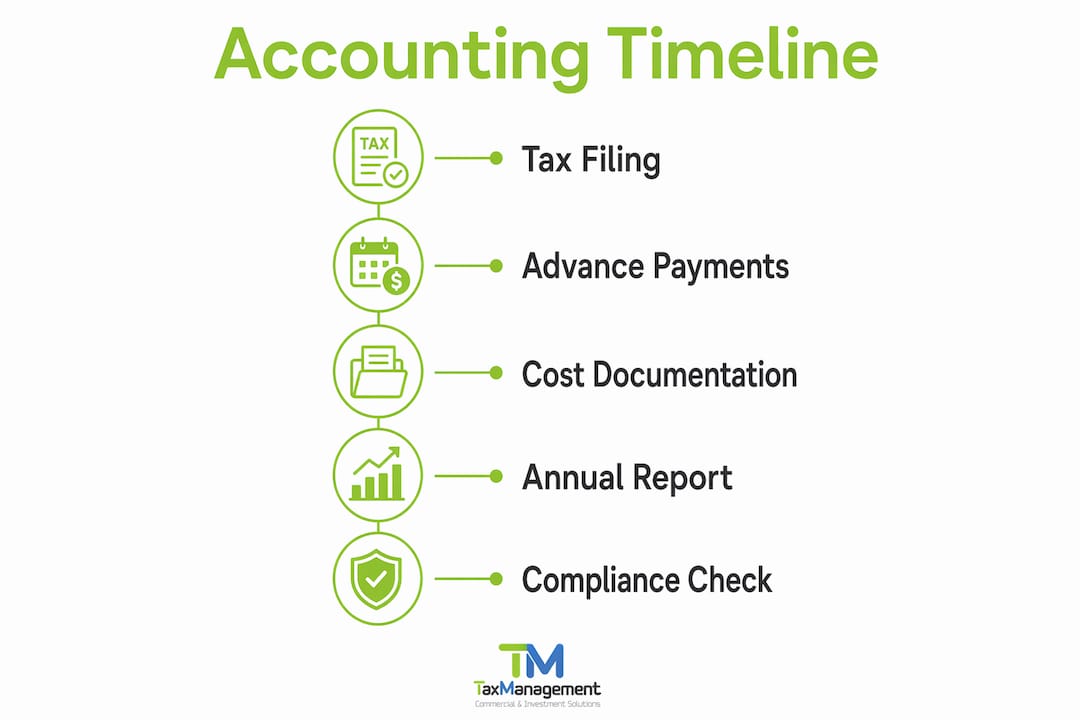
| Obligation | Deadline | Filed With |
|---|---|---|
| Annual Tax Declaration | June 30, 2026 | National Revenue Agency |
| Annual Activity Report | June 30, 2026 | National Statistical Institute |
| Financial Statements | June 30, 2026 | Commercial Register |
| Monthly advance tax | 15th of each month | National Revenue Agency |
How do tax obligations and incentive schemes affect financial management for production companies?
Bulgaria’s corporate tax rate is 10% on taxable profit, one of the lowest in the European Union. That rate gives production companies a meaningful cost advantage compared to operating in Western European jurisdictions. Dividend withholding tax for local physical persons stands at 5%, while rates for foreign shareholders depend on applicable tax treaties.
Advance corporate tax payments follow a threshold-based schedule:
- Companies with prior-year revenue below €300,000 make quarterly advance payments
- Companies with prior-year revenue above €300,000 make monthly advance payments
- Newly established companies are generally exempt from advance payments in their first year
The most significant recent development for production company financial planning is the film incentive scheme expansion. The Bulgarian government raised the maximum reimbursable production costs from 2 million BGN to €5 million per project. This change attracted over 170 million BGN in foreign investment between 2022 and 2024. For high-budget international productions, this incentive is a primary reason to choose Bulgaria as a filming location.
Capturing this incentive in your accounting records requires precise cost documentation from day one. Every eligible expense, including equipment rental, location fees, and local crew wages, must be tracked against the incentive criteria. Submitting incomplete or poorly documented cost reports results in partial or denied reimbursements. Production company bookkeeping must therefore be structured around incentive eligibility categories, not just standard expense classifications.
Pro Tip: Create a dedicated cost center in your accounting system specifically for incentive-eligible expenses. Mixing these with general overhead makes it nearly impossible to compile a clean reimbursement claim later.
For production companies considering tax optimization strategies, Bulgaria’s low corporate tax rate combined with the film incentive scheme creates a genuinely favorable environment. The key is aligning your accounting structure with both sets of rules from the start of each project.
What are the best practices for budgeting and bookkeeping in film and media production?
Budgeting for film projects requires a level of granularity that standard business accounting rarely demands. A production budget typically breaks down into above-the-line costs (creative talent, rights, and producers) and below-the-line costs (crew, equipment, locations, and post-production). Tracking these two categories separately is standard industry practice and directly affects how financial statements reflect project profitability.
The following numbered steps describe the core financial management workflow for production companies:
- Create a line-item production budget before any spending begins. Every department head submits cost estimates, which the financial manager consolidates into a master budget document.
- Open a dedicated bank account for each production. Commingling project funds with general company accounts creates reconciliation problems and complicates tax filings.
- Apply accrual accounting for all production expenses. Costs are recognized when incurred, not when paid. Pre-paid expenses, such as location deposits paid months before filming, must be recognized as assets and expensed over the relevant period.
- Conduct weekly cost reports comparing actual spending against the approved budget. Variances above 5% in any department warrant immediate review.
- Retain all source documents including contracts, invoices, and receipts. The National Revenue Agency requires these during audits, and incomplete documentation is the most common trigger for tax adjustments.
Accrual accounting is particularly important for production companies because large expenses often precede revenue by months or years. A film completed in one fiscal year may not generate distribution revenue until the next. Recognizing costs and revenues in the correct periods prevents material misstatements in financial statements.
Outsourcing production company bookkeeping is standard practice for small and medium firms. Accounting fees in Bulgaria range from €75 to €200 per month for small companies and €200 to €500 per month for medium-sized entities. Outsourcing gives production companies access to qualified accountants without the overhead of a full-time finance department. The cost is predictable and typically far lower than the penalties or lost incentives that result from poor financial management.
Pro Tip: When selecting an outsourced accountant, ask specifically about their experience with film production incentive claims and royalty accounting. General accountants often miss sector-specific nuances that cost production companies money.
How to ensure compliance in annual financial statement preparation?
Annual financial statement preparation is a legal obligation, not an optional reporting exercise. Legal advisors confirm that publishing annual financial statements is now a critical compliance pillar, and ignoring it risks investigations and operational restrictions. Production company owners must treat this process as a fixed operational deadline, not a year-end administrative task.
The preparation process involves these key steps:
- Reconcile all accounts by December 31 of the reporting year. Bank statements, supplier invoices, and payroll records must match the general ledger.
- Prepare the full financial statement package: balance sheet, income statement, cash flow statement, and notes.
- Have statements reviewed or audited if the company meets the statutory thresholds for mandatory audit under Bulgarian law.
- File with all three bodies: the National Revenue Agency, the National Statistical Institute, and the Commercial Register, all by June 30.
- Coordinate legal and accounting teams to confirm that corporate governance disclosures in the statements align with the company’s registered documents.
Fines for non-compliance range from €250 to €1,500 for individuals and €250 to €2,500 for legal entities. Repeated violations double those amounts. Beyond fines, non-compliance complicates access to bank financing and can block legal changes to the company’s registered structure. For production companies that depend on project-based financing, this is a material operational risk.
Transparent and accurate reporting also builds credibility with international co-producers and distributors. Foreign partners conducting due diligence on a Bulgarian production company will request financial statements. Clean, timely filings signal professional management and reduce friction in deal negotiations.
For a full overview of financial reporting obligations applicable to foreign-owned production entities in Bulgaria, the requirements align closely with those for domestic companies, with additional considerations for transfer pricing and cross-border transactions.
What are the emerging challenges in production accounting in Bulgaria?
Bulgaria’s film industry is growing in complexity, and the accounting demands are growing with it. The recent expansion of the film incentive scheme is the most visible change, but the legislative environment around production finance continues to shift. Proactive accountants monitor regulatory updates because delays in implementing new rules have historically caused disruptions for production companies mid-project.
Revenue streams for production companies now extend well beyond box office receipts. Royalties, licensing payments, streaming rights, and music synchronization fees each carry distinct recognition rules under NSS. The scale of this complexity is visible in the creative sector broadly: Musicautor distributed over €8.1 million to nearly 200,000 rights holders in a single distribution cycle. That figure reflects how significant and administratively complex royalty flows have become for anyone operating in the creative industries.
The key challenges production company financial managers face in 2026 include:
- Incentive timing mismatches: reimbursements from the film incentive scheme arrive after production ends, creating cash flow gaps that require careful planning
- Multi-jurisdiction tax exposure: international co-productions trigger tax obligations in multiple countries, requiring coordination between Bulgarian and foreign accountants
- Royalty and licensing recognition: each revenue type has specific recognition timing rules that general accountants may apply incorrectly
- Legislative monitoring: amendments to the film incentive law and corporate tax rules require ongoing attention to avoid compliance gaps
Specialized accountants who understand the film industry’s financial workflows are better positioned to handle these challenges than generalists. The cost of hiring a specialist is consistently lower than the cost of correcting errors after a tax audit or a failed incentive claim. Production companies that invest in sector-specific financial expertise gain a measurable advantage in both compliance and profitability.
For production company owners who want to stay current on Bulgarian tax developments, the TaxManagement news and insights section covers regulatory updates relevant to the film and media sector.
Key Takeaways
Effective accounting for production companies in Bulgaria requires combining NSS-compliant bookkeeping, precise incentive cost tracking, and timely annual filings across three regulatory bodies by June 30 each year.
| Point | Details |
|---|---|
| NSS and double-entry bookkeeping | All production companies must use National Accounting Standards with chronological double-entry records. |
| June 30 filing deadline | Tax declarations, activity reports, and financial statements all share the same annual deadline. |
| Film incentive up to €5 million | Reimbursable production costs now reach €5 million per project, requiring dedicated cost tracking from day one. |
| Corporate tax at 10% | Bulgaria’s flat corporate tax rate is among the lowest in the EU, making it favorable for production entities. |
| Outsourcing costs €75–€500 per month | Small and medium production companies typically outsource bookkeeping at predictable monthly rates. |
How TaxManagement supports production companies
TaxManagement has over 20 years of experience helping more than 1,500 firms manage accounting, tax compliance, and company registration in Bulgaria. Production company owners and financial managers who need support with annual financial statement preparation, corporate tax filings, or film incentive documentation can access a full range of accounting and bookkeeping services designed for small and medium production entities. TaxManagement’s team combines legal, accounting, and regulatory expertise to handle the specific demands of the film and media sector. Contact TaxManagement directly to discuss a compliance and reporting structure tailored to your production company’s needs.
FAQ
What accounting standards do production companies in Bulgaria follow?
Production companies in Bulgaria follow the National Accounting Standards (NSS) and must use double-entry bookkeeping recorded in chronological order, as required by the Bulgarian Accounting Act. Large entities or public interest entities may be required to apply IFRS instead.
What is the corporate tax rate for production companies in Bulgaria?
The corporate tax rate is 10% on taxable profit, one of the lowest in the EU. Dividend withholding tax for local physical persons is 5%.
What is the film production incentive limit in Bulgaria for 2026?
The Bulgarian government raised the maximum reimbursable production costs to €5 million per project in early 2026. This change is designed to attract high-budget international productions and requires precise cost documentation to claim.
What are the penalties for missing the June 30 filing deadline?
Fines range from €250 to €1,500 for individuals and €250 to €2,500 for legal entities. Repeated violations double those amounts, and non-compliance can restrict access to bank financing and block legal changes to the company’s structure.
How much does outsourced accounting cost for a production company in Bulgaria?
Small production companies typically pay €75 to €200 per month for outsourced accounting services. Medium-sized entities pay €200 to €500 per month, depending on transaction volume and reporting complexity.