


TL;DR:
- Bulgarian national insurance contributions are mandatory payments covering social security and health insurance for all residents and workers in Bulgaria. For 2026, the total contribution rate is between 32.7% and 33.4%, divided between employers and employees, with contributions capped at a maximum insurable income of €2,111.64 per month. Self-insured individuals, including freelancers, pay about 27.8% based on declared income, while health insurance contributions total 8%, providing access to various public healthcare services.
Bulgarian national insurance contributions are mandatory payments covering social security and health insurance, required by law for all employed and self-insured persons working or residing in Bulgaria. The system operates under the Bulgarian Social Insurance Code and applies to expats and foreign investors just as it does to Bulgarian nationals. For 2026, the total contribution rate ranges from 32.7% to 33.4%, split between employer and employee. Understanding this system is the first step toward full compliance and informed financial planning in Bulgaria.
What is the Bulgarian national insurance contributions guide for 2026?

Bulgarian national insurance contributions, formally known as social security and health insurance contributions, cover seven distinct funds. These funds include the state pension fund, supplementary pension, health insurance, general sickness and maternity, unemployment, and occupational accidents and diseases. Every employed person in Bulgaria contributes to most or all of these funds, depending on their employment category.
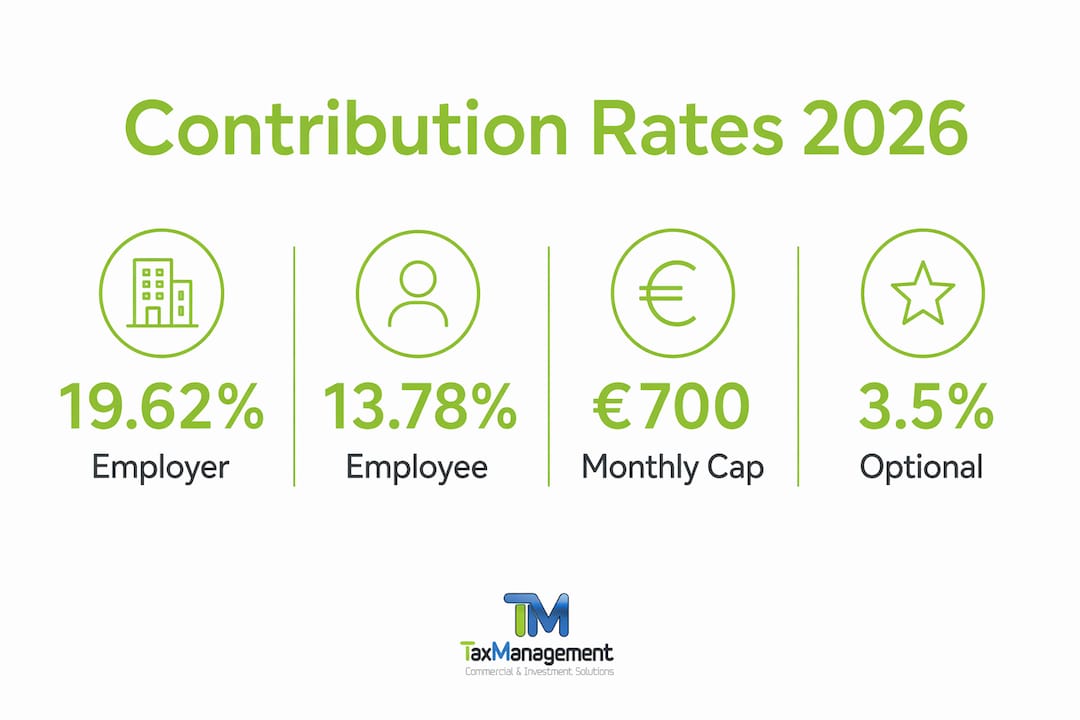
The total contribution split for 2026 places 18.92%–19.62% on the employer and 13.78% on the employee. That means for every euro of gross salary, roughly one third goes directly to the social security system before income tax is even calculated. Foreign investors who focus only on Bulgaria’s flat 10% personal income tax often underestimate the real labor cost burden.
Contributions apply to insurable income, not total gross pay. The minimum monthly insurable income is €550.66, and the maximum is €2,111.64. Any salary above €2,111.64 per month is not subject to additional social security contributions. This cap is a significant advantage for high earners and companies paying competitive salaries.
Here is a breakdown of the main contribution rates by fund for 2026:
- State pension fund: 19.8% total (split between employer and employee)
- Supplementary mandatory pension: 5% total
- Health insurance (NHIF): 8% total (4.8% employer, 3.2% employee)
- General sickness and maternity: 3.5% total
- Unemployment: 1% total
- Occupational accidents and diseases: 0.4%–1.1% depending on industry
The maximum total social security payment is capped at approximately €700 per month regardless of earnings above the income ceiling. That ceiling protects both employers and employees from open-ended contribution liability.
Pro Tip: When budgeting for a new hire in Bulgaria, calculate the employer’s social security cost as approximately 19%–20% on top of the agreed gross salary, up to the €2,111.64 monthly cap. This gives you a reliable labor cost ceiling from day one.
How do self-insured persons and freelancers handle contributions?
Self-insured persons, which include freelancers, sole traders, and self-employed expats, carry the full contribution burden themselves. Unlike employees, they have no employer to share the cost. The contribution rate for self-insured persons is approximately 27.8% on declared income.
The declared income base must fall between €550.66 and €2,111.64 per month. Self-employed individuals choose their own declared income within this range, which directly affects both their contribution amount and the benefits they accumulate. Declaring the minimum keeps costs low but reduces future pension and benefit entitlements.
The practical steps for self-insured compliance are straightforward:
- Register with the National Revenue Agency (NRA) as a self-insured person.
- Declare your chosen monthly income base at or above €550.66.
- Calculate contributions at approximately 27.8% of the declared base.
- Pay contributions monthly, by the 25th of the following month.
- File an annual income tax return by april 30 of the following year.
At the minimum base of €550.66, monthly contributions total approximately €153. At the maximum base of €2,111.64, the monthly figure rises to approximately €587. These amounts cover the mandatory pension, supplementary pension, and health insurance funds.
Self-insured persons can also opt into general sickness and maternity insurance at an additional 3.5% contribution rate. This optional coverage provides access to sick pay and maternity benefits under the state system. Expats planning to start a family or who want income protection during illness should seriously consider adding this coverage.
Pro Tip: Self-employed expats who declare income close to the maximum base build stronger pension entitlements and qualify for higher sickness benefits. The additional cost is modest relative to the long-term benefit, particularly for those planning to remain in Bulgaria for several years.
What are the mandatory health insurance contributions and coverage in Bulgaria?
Health insurance in Bulgaria is administered by the National Health Insurance Fund (NHIF), known locally as NZOK. Every employed and self-insured person must contribute to the NHIF as part of the standard contribution package. The total health insurance rate is 8% of insurable income, with the employer paying 4.8% and the employee paying 3.2%. Self-insured persons pay the full 8% themselves.
At the minimum income base, the monthly health insurance contribution is approximately €44. At the maximum base, it reaches approximately €169. These amounts are included within the overall contribution calculations described above, not added on top.
NHIF membership provides access to the following public healthcare services:
- GP consultations and referrals
- Hospital treatment and surgery
- Maternity and newborn care
- Diagnostic tests and laboratory work
- Subsidized prescription medications
- Dental care for children
Important for expats: NHIF coverage is mandatory for all work permit holders in Bulgaria, including EU citizens who do not hold a valid A1 certificate. Enrollment is automatic upon employment registration. However, public healthcare facilities can have long wait times for specialist appointments, and the quality of facilities varies significantly by region.
Most expats in Bulgaria maintain both mandatory NHIF contributions and a private health insurance plan. Private supplementary insurance typically costs between €300 and €800 per year and provides faster access to specialists, English-speaking doctors, and higher-quality private hospitals. The combination of public NHIF coverage and private insurance gives expats the most practical level of healthcare access.
The NHIF does not cover dental care for adults, vision correction, or most cosmetic procedures. Private plans typically fill these gaps. For expats relocating with families, the annual cost of private coverage for a household of four can reach €2,000–€3,000, which should be factored into relocation budgets.
How can expats and foreign investors ensure compliance and optimize contributions?
Compliance with Bulgarian national insurance obligations starts with correct registration. Employers must register with the National Revenue Agency before hiring any employee, and employees must be registered before their first working day. Late registration triggers penalties and back-payment obligations.
The key compliance steps for expats and foreign investors are:
- Register the employing entity or self-employment status with the NRA before any work begins.
- Obtain an A1 certificate from your home country’s social security authority if you are an EU citizen continuing to contribute in your home state.
- File monthly contribution declarations by the 25th of the following month.
- Pay contributions on time to avoid interest charges and enforcement action.
- Keep payroll records for at least five years, as the NRA conducts routine audits.
The A1 certificate is the most commonly overlooked compliance tool for EU citizens. It confirms that a worker continues to pay social security in their home EU country and is therefore exempt from Bulgarian contributions. Without a valid A1 certificate, mandatory Bulgarian enrollment applies automatically, creating unexpected costs for both the individual and their employer.
For high earners, the income cap at €2,111.64 per month creates a natural optimization point. Once salary exceeds this threshold, additional income carries no further social security burden. The effective contribution rate therefore decreases as income rises above the cap. This makes Bulgaria particularly attractive for senior executives and high-earning professionals relocating within the EU.
A Bulgarian tax contributions overview for 2026 shows that combining the 10% flat income tax with capped social security contributions produces a total tax burden that is among the lowest in the EU for mid-to-high income earners. Foreign investors who structure their compensation correctly can achieve significant savings compared to most Western European jurisdictions.
Pro Tip: If you are an EU citizen working remotely for a foreign employer while living in Bulgaria, confirm your A1 certificate status before assuming you are exempt from Bulgarian social security. The rules depend on where your employer is registered and where you habitually work, not just where you live.
Key Takeaways
Bulgarian national insurance contributions require careful planning from both employers and self-employed expats, as the combined rate of 32.7%–33.4% applies to all insurable income up to the €2,111.64 monthly cap.
| Point | Details |
|---|---|
| Total contribution rate | The combined employer and employee rate ranges from 32.7% to 33.4% for 2026. |
| Income cap protection | Contributions are capped at a maximum insurable income of €2,111.64 per month, limiting total liability. |
| Self-insured rate | Freelancers and self-employed expats pay approximately 27.8% on declared income between €550.66 and €2,111.64. |
| Health insurance split | The NHIF rate is 8% total: 4.8% employer and 3.2% employee, or full 8% for self-insured persons. |
| A1 certificate exemption | EU citizens with a valid A1 certificate from their home country are exempt from Bulgarian social security enrollment. |
TaxManagement’s support for expats managing Bulgarian contributions
Navigating Bulgarian social security and health insurance obligations requires accurate payroll setup, timely filings, and an understanding of both local law and EU coordination rules. TaxManagement has supported more than 1,500 international firms with exactly this kind of compliance work over more than 20 years of practice in Bulgaria.
TaxManagement’s accounting services in Bulgaria cover contribution calculations, NRA registration, monthly declaration filing, and payroll reporting for both employed staff and self-insured directors. The team includes legal, accounting, and IT professionals who work together to keep foreign-owned entities fully compliant with Bulgarian and EU regulations. For expats and investors who want reliable contribution management without the administrative burden, TaxManagement provides a direct path to compliance and cost clarity.
FAQ
What is the total national insurance contribution rate in Bulgaria for 2026?
The total rate ranges from 32.7% to 33.4%, split between the employer at 18.92%–19.62% and the employee at 13.78%. Contributions apply only to insurable income up to the monthly cap of €2,111.64.
Are expats exempt from Bulgarian national insurance contributions?
EU citizens holding a valid A1 certificate from their home country’s social security authority are exempt. Without this certificate, mandatory enrollment in the Bulgarian system applies regardless of nationality.
How much do self-employed expats pay in social security contributions in Bulgaria?
Self-insured persons pay approximately 27.8% on a declared monthly income between €550.66 and €2,111.64. At the minimum base, this equals roughly €153 per month.
Does mandatory NHIF health insurance cover all medical expenses for expats?
NHIF covers GP visits, hospital care, maternity, diagnostics, and subsidized medications, but excludes adult dental care and vision. Most expats add private insurance costing €300–€800 per year to supplement public coverage.
When must Bulgarian national insurance contributions be paid each month?
Contributions must be paid by the 25th of the month following the month in which the income was earned. Late payments attract interest charges and may trigger NRA enforcement action.