


TL;DR:
- Bulgaria’s VAT compliance involves registration, filing, invoicing, and reporting under the Bulgarian VAT Act. Foreign businesses face strict deadlines and obligations, with potential fines for late or incorrect submissions. Starting in 2026, all VAT declarations must be in euros due to Bulgaria’s entry into the Eurozone.
VAT accounting compliance in Bulgaria is defined as the full set of legal obligations a business must meet under the Bulgarian Value Added Tax Act, including registration, filing, invoicing, and reporting requirements enforced by the National Revenue Agency (NRA). For foreign entrepreneurs and international businesses, these obligations carry real financial consequences: late registration, missed deadlines, or incorrect invoices can each trigger administrative fines, rejected refund claims, or formal audits. Bulgaria’s entry into the Eurozone on january 1, 2026, added a new layer to this framework, as all VAT declarations now use Euro rather than Bulgarian lev. This guide covers every critical requirement your business needs to meet in 2026.
What are the VAT registration requirements and deadlines in Bulgaria?
The VAT registration threshold for resident businesses in Bulgaria is €51,130 (BGN 100,000) in taxable turnover, measured on a rolling 12-month basis. Once your turnover crosses that threshold, you have 7 days after the end of the month in which the breach occurred to submit a registration application to the NRA. Missing that window exposes your business to fines and back-dated VAT liability.
Non-resident businesses face a stricter rule. There is no turnover threshold for foreign companies conducting taxable activities in Bulgaria. Registration is required immediately upon the first taxable supply. This distinction catches many foreign entrepreneurs off guard, particularly those accustomed to threshold-based rules in their home countries.
Several categories of activity trigger separate registration rules:
- Digital services supplied to Bulgarian consumers: Businesses may register under the EU One Stop Shop (OSS) scheme rather than registering directly in Bulgaria.
- Intra-community acquisitions: A separate registration obligation applies when the value of goods acquired from other EU member states exceeds €20,000 per calendar year.
- Distance sales: The EU-wide OSS threshold of €10,000 applies for cross-border transaction reporting in Bulgaria, after which local or OSS registration becomes mandatory.
- Voluntary registration: Businesses below the threshold may register voluntarily, which is often advantageous for recovering input VAT on startup costs.
For foreign companies, consulting a specialist before your first Bulgarian transaction is the most reliable way to determine which registration route applies. TaxManagement provides VAT registration guidance specifically for international businesses entering the Bulgarian market.
Pro Tip: Track your cumulative taxable turnover monthly, not quarterly. A single large contract can push you over the €51,130 threshold mid-year, and the 7-day application deadline leaves almost no time to react if you are monitoring figures infrequently.
How to correctly prepare and file VAT returns on time?

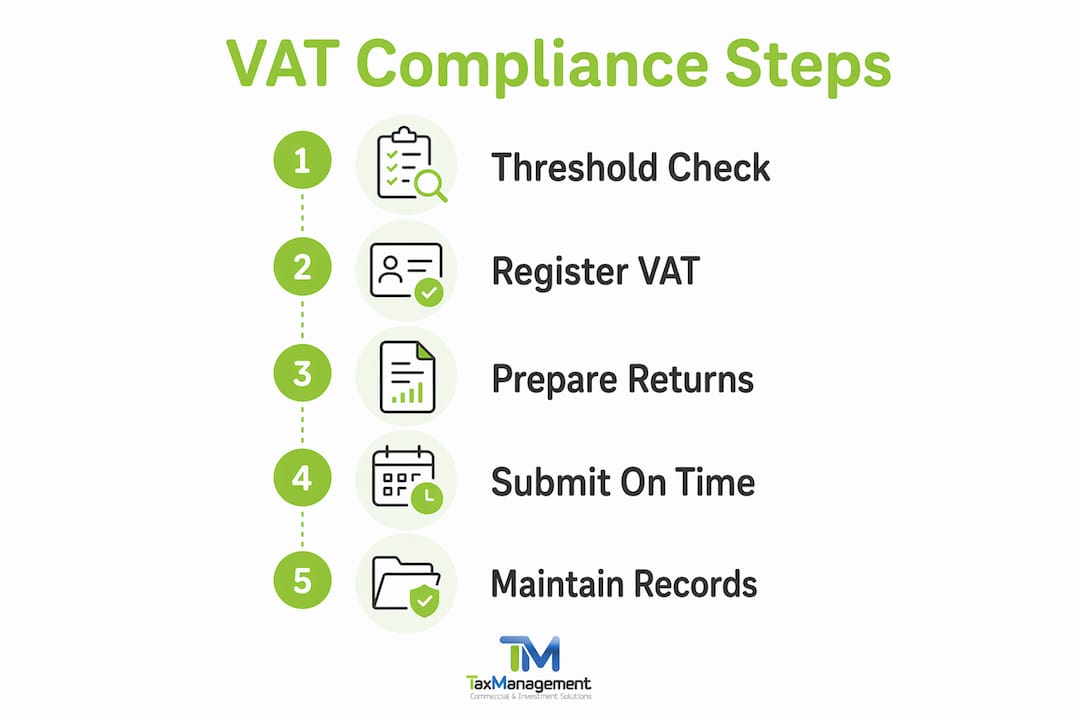
Monthly VAT returns are the core of Bulgaria’s monthly accounting obligations. Every VAT-registered business must file electronically by the 14th day of the month following the reporting period. The return must be accompanied by two supporting ledgers: a purchase ledger and a sales ledger, both submitted through the NRA’s electronic portal using a qualified digital signature.
The filing process follows a clear sequence:
- Reconcile all transactions for the reporting month, matching invoices received and issued against your accounting records. Reconciling accounts under Bulgarian regulations requires that every entry ties back to a valid VAT document.
- Prepare the purchase and sales ledgers in the format prescribed by the NRA. Each ledger lists individual invoice details, including supplier or customer VAT IDs, invoice dates, and VAT amounts.
- Complete the VAT return form by aggregating figures from both ledgers. Output VAT minus deductible input VAT produces the net amount due or refundable.
- Submit electronically through the NRA portal before the 14th of the following month. Payment of any VAT due must also clear by that date.
- Retain all supporting documents for a minimum of 5 years, as NRA audits focus heavily on input tax credit claims and invoice validity within that limitation period.
Late filing penalties range from €250 to €5,000 depending on the business’s compliance history. A first-time breach typically attracts a lower fine, but repeat violations escalate quickly. Interest charges also accrue on any unpaid VAT from the due date. The combined cost of a missed deadline, fines plus interest, routinely exceeds the cost of professional accounting support for an entire year.
A practical monthly financial reporting workflow for Bulgaria should include a mid-month internal review, no later than the 10th, to catch discrepancies before the filing deadline. This buffer allows time to correct errors without rushing.
What are the invoicing standards required for VAT compliance?
A valid Bulgarian VAT invoice is not simply a payment request. It is a legal document that determines whether your customer can claim input VAT and whether you can defend your output VAT position in an audit. Bulgarian VAT invoices must include the supplier’s Bulgarian VAT identification number, the correct VAT rate applied, a sequential invoice number, the tax point date, and a full description of the goods or services supplied.
Invoices must be issued within five days after the tax point, which is generally the date of supply or the date of payment receipt, whichever comes first. For intra-community supplies to other EU businesses, the invoice must also reference the customer’s EU VAT number and include the notation “reverse charge” where applicable. OSS-related transactions carry their own documentation requirements under EU Directive 2006/112/EC.
Key invoicing requirements under Bulgarian VAT law include:
- B2B domestic transactions: Full VAT invoice with all mandatory fields; VAT charged at the standard rate of 20% unless a reduced rate or exemption applies.
- B2G transactions: Government procurement rules may require additional fields or electronic invoice formats aligned with the European standard EN 16931.
- Intra-community supplies: Zero-rated with reverse charge notation; customer’s EU VAT number is mandatory.
- Exports outside the EU: Zero-rated with customs documentation as supporting evidence.
Incorrect or incomplete invoices lead directly to rejected VAT refund claims during NRA audits. A missing VAT ID or an incorrect tax point date is sufficient grounds for the NRA to disallow an input tax deduction. This makes invoice quality a direct financial risk, not an administrative formality.
Pro Tip: Maintain a dedicated invoice register that flags any document missing mandatory fields before it leaves your accounts payable or receivable workflow. Catching errors at issuance costs nothing. Correcting them during an audit costs significantly more.
How to handle annual financial statements and yearly accounting obligations?
Annual financial statements (AFS) are a separate obligation from VAT returns, but they form a critical part of the broader Bulgarian accounting compliance checklist. The AFS for the 2025 calendar year must be published in the Bulgarian Commercial Register by september 30, 2026. Companies with no activity during 2025 must file a declaration of inactivity by june 30, 2026.
The table below summarizes the key annual deadlines and consequences for 2026:
| Obligation | Deadline | Consequence of non-compliance |
|---|---|---|
| Annual Financial Statements (2025) | September 30, 2026 | Manager fines from €102 to €1,534 |
| Declaration of inactivity (2025) | June 30, 2026 | Same fine range applies |
| Capital redenomination to Euro | January 1, 2026 | Required for all company filings |
| Corporate tax return | March 31, 2026 | Separate penalty regime applies |
Filing the AFS is free of charge through the Commercial Register’s electronic portal. However, the statements must be prepared in accordance with the National Accounting Standards (NAS) or International Financial Reporting Standards (IFRS), depending on the company’s size and classification. Bulgaria’s adoption of the Euro in 2026 also requires that company capital be redenominated in Euro across all filings. For detailed guidance on annual reporting obligations for foreign-owned entities, TaxManagement’s resource on financial reporting for foreign firms covers the full process.
What special considerations apply to foreign businesses on VAT recovery?
Foreign businesses face a materially different compliance path than Bulgarian residents, particularly when it comes to VAT recovery. Non-resident businesses must register immediately upon conducting any taxable activity in Bulgaria, with no minimum turnover threshold. This rule applies regardless of whether the business has a physical presence in the country.
VAT refund procedures diverge sharply between EU and non-EU entities. EU-based businesses claim refunds through their own country’s tax authority portal under the EU VAT Refund Directive (Council Directive 2008/9/EC). Non-EU businesses must file paper claims directly with the NRA and are subject to reciprocal agreement conditions. A non-EU company from a country without a reciprocal VAT agreement with Bulgaria cannot recover Bulgarian VAT at all.
| Factor | EU-resident businesses | Non-EU businesses |
|---|---|---|
| Registration threshold | €51,130 for residents; immediate for non-residents with taxable supplies | Immediate upon any taxable activity |
| Refund claim method | Electronic portal via home country tax authority | Paper claim submitted directly to NRA |
| Local VAT agent required | No | Yes, mandatory |
| Reciprocal agreement required | No | Yes, required for refund eligibility |
| Invoice compliance standard | Bulgarian VAT Act requirements | Bulgarian VAT Act requirements |
TaxManagement’s accounting services for Bulgarian VAT compliance
TaxManagement has supported more than 1,500 international businesses with company registration and accounting services in Bulgaria, backed by over 20 years of direct experience with Bulgarian and EU tax law. For 2026, the firm’s services cover VAT registration for both resident and non-resident businesses, monthly return preparation and electronic filing, invoice compliance reviews, and AFS preparation under NAS or IFRS. All consulting engagements are backed by professional indemnity insurance, which provides clients with a formal layer of financial protection against errors. Businesses that need to comply with Bulgarian financial regulations without building an in-house accounting function can engage TaxManagement’s team directly through their consulting services page.
Key Takeaways
Effective VAT accounting compliance in Bulgaria requires meeting registration thresholds, filing monthly returns by the 14th, issuing compliant invoices within five days of the tax point, and publishing annual financial statements by september 30 each year.
| Point | Details |
|---|---|
| VAT registration threshold | Resident businesses must register once turnover reaches €51,130; non-residents register immediately. |
| Monthly filing deadline | VAT returns and ledgers must be filed electronically by the 14th of the following month. |
| Penalty exposure | Late filing fines range from €250 to €5,000, plus interest on unpaid VAT. |
| Invoice requirements | Invoices must include the Bulgarian VAT ID and be issued within five days of the tax point. |
| Annual statements deadline | AFS for 2025 must be published by September 30, 2026, with manager fines up to €1,534 for non-compliance. |
FAQ
What is the VAT registration threshold in Bulgaria for 2026?
The threshold for resident businesses is €51,130 in taxable turnover over a rolling 12-month period. Non-resident businesses have no threshold and must register immediately upon their first taxable supply in Bulgaria.
When must Bulgarian VAT returns be filed each month?
VAT returns, together with purchase and sales ledgers, must be submitted electronically to the NRA by the 14th day of the month following the reporting period.
What are the penalties for late VAT filing in Bulgaria?
Late filing penalties range from €250 to €5,000 depending on the business’s prior compliance record, with additional interest charges accruing on any unpaid VAT from the due date.
Do non-EU businesses need a local VAT agent in Bulgaria?
Yes. Non-EU businesses filing VAT refund claims in Bulgaria must appoint a local fiscal representative, who assumes joint liability for the company’s VAT obligations and submits paper claims directly to the NRA.
When is the deadline for annual financial statements in Bulgaria?
Annual financial statements for the 2025 fiscal year must be published in the Bulgarian Commercial Register by september 30, 2026. Companies with no activity must file a declaration of inactivity by june 30, 2026.