


Corporate governance compliance in Bulgaria is defined as the set of legal obligations companies must fulfill under the Bulgarian Commercial Act, the Measures Against Money Laundering Act (AMLA), and applicable EU directives to maintain lawful operation and transparency. For businesses and investors, this means meeting specific filing deadlines, maintaining accurate beneficial ownership records, and aligning board conduct with both Bulgarian and EU standards. The Bulgarian Commercial Register and the UBO Register are the two primary public registries where most compliance obligations are recorded. Getting these obligations right from the start protects your company from administrative fines, forced liquidation, and reputational damage in one of the EU’s most cost-effective jurisdictions for international business.
What are the mandatory corporate governance compliance requirements in bulgaria?
Bulgarian corporate law sets out clear, non-negotiable obligations for every registered company, regardless of whether it is actively trading. The Bulgarian Commercial Act governs the core structure of these requirements, covering financial reporting, general meetings, and board accountability.
Annual financial statements are the most time-sensitive obligation. Companies must file annual financial statements by June 30 or September 30, depending on their category, and inactive companies must submit inactivity declarations by the same deadlines. Missing these dates triggers administrative fines ranging from €250 to €1,500 for companies and €100 to €500 for individual directors. Repeated non-compliance can result in forced liquidation, which is a risk no investor should underestimate.

Large companies and public interest entities in Bulgaria must prepare their statements under IFRS, while smaller entities may apply national accounting standards. This distinction directly affects the complexity and cost of your annual reporting process.
Key mandatory requirements include:
- Annual financial statements or inactivity declarations filed by the statutory deadline each year
- At least one general meeting annually, with resolutions documented in properly formatted minutes; major decisions may require notarization
- Board of directors oversight, with directors personally liable for compliance failures
- Digital filings using qualified electronic signatures (QES), which are recognized across the EU and are now the standard method, replacing paper submissions
- Registration and maintenance of UBO data in the Bulgarian Commercial Register
Pro Tip: Set calendar reminders for both the June 30 and September 30 deadlines at the start of each fiscal year. Even dormant companies must file inactivity declarations, and directors who miss this are personally exposed to fines.
How to manage UBO registration and stay compliant with AMLA
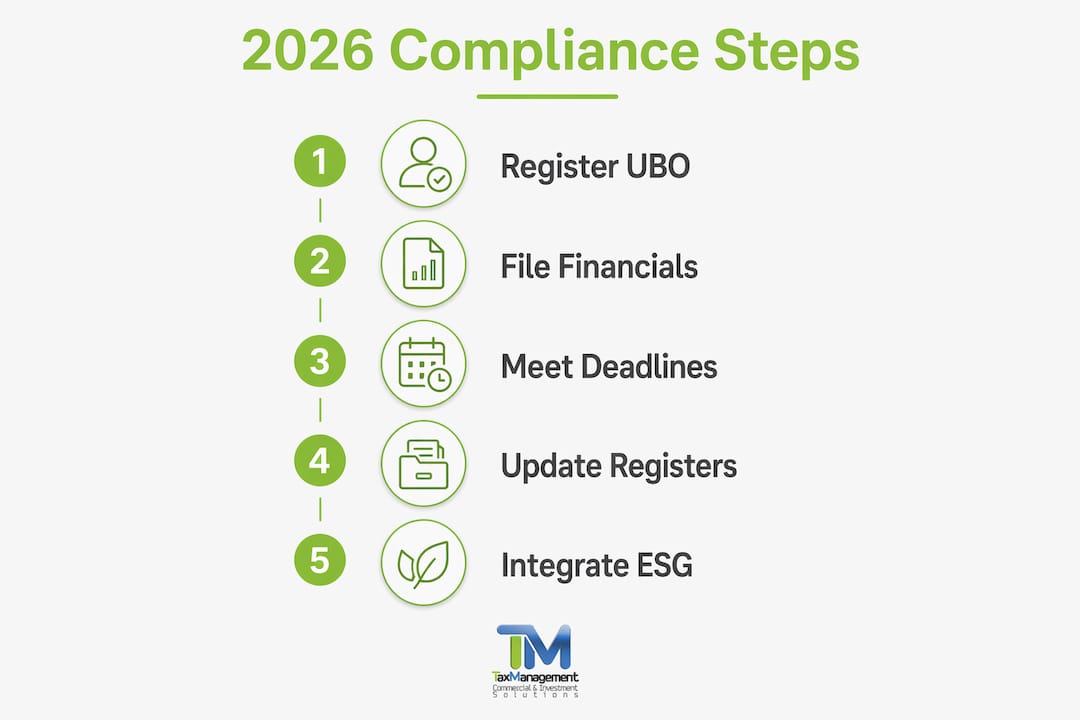
Ultimate Beneficial Owner (UBO) registration is one of the most closely monitored compliance requirements under Bulgaria’s anti-money laundering framework. A UBO is any natural person who directly or indirectly holds more than 25% of the ownership or voting rights in a company, or who otherwise exercises effective control over it.
The registration process follows a defined sequence:
- Identify all natural persons who meet the 25% ownership or control threshold within your company’s ownership structure.
- Register their details in the Bulgarian Commercial Register, including full name, date of birth, nationality, and the nature and extent of the beneficial interest held.
- Monitor for changes in shareholding or control arrangements that would alter UBO status, and update the register promptly.
- Handle discrepancies reported by obliged entities (such as accountants or banks) within the required timeframes: discrepancies must be notified within 14 days and corrected within 7 days of notification.
- Apply the fallback rule if no natural person exceeds the 25% threshold. In that case, the senior managing official must be declared as the UBO. This rule is frequently overlooked by foreign investors and directors.
The financial consequences of non-compliance are significant:
Violation TypeFine RangeInitial UBO registration failureUp to €1,023 per monthRepeat or uncorrected violations€1,023 to €25,565 per monthFailure to correct after notificationFines double and continue monthly
The discrepancy notification obligation under AMLA represents a significant expansion of responsibilities for obliged entities like accountants and auditors. They are now required to cross-check client UBO data against the register and report any inconsistencies they discover. This means your external advisors are effectively a second layer of oversight on your UBO accuracy.
Pro Tip: If your company has a complex multi-tier ownership structure, map the full chain of ownership to the natural person level before registering. Errors at this stage are the most common trigger for discrepancy notifications and subsequent fines.
How should boards integrate ESG into bulgarian corporate governance?
Environmental, Social, and Governance (ESG) criteria are no longer optional considerations for boards operating in Bulgaria. The Bulgarian National Corporate Governance Code and EU directives including the Corporate Sustainability Reporting Directive (CSRD) and the EU Taxonomy Regulation now set clear expectations for how boards govern sustainability matters.
Boards and managing directors carry direct responsibility for ESG oversight. This includes setting sustainability strategies, approving measurable targets, and reviewing non-financial disclosures before publication. The board’s ESG responsibilities extend to approving targets and reviewing sustainability disclosures, which means ESG is now a board-level governance function, not just a reporting exercise.
Practical steps for embedding ESG into your governance structure include:
- Establish a dedicated committee for audit, risk, or sustainability oversight, with clear terms of reference and reporting lines to the full board
- Integrate ESG risks into the company’s overall risk management framework, treating climate and social risks with the same rigor as financial risks
- Align non-financial reporting with CSRD requirements and the EU Taxonomy, particularly if your company operates across multiple EU member states
- Monitor data quality for sustainability disclosures, since inaccurate ESG data is one of the most common weaknesses identified in regulatory reviews
“Boards should go beyond statutory compliance to embed ESG at the governance level, forming committees and integrating sustainability risks into strategic decisions.” — ICLG ESG Report 2026 Bulgaria
Proactive ESG integration also carries a commercial benefit. Investors and institutional lenders increasingly screen for governance quality before committing capital. A company with a functioning sustainability committee and documented ESG targets presents a materially lower risk profile than one that treats ESG as a disclosure formality.
For companies considering their corporate structure in Bulgaria, understanding how OOD company obligations interact with ESG reporting requirements is a practical starting point.
How to maintain ongoing compliance and avoid common mistakes
Ongoing corporate governance compliance in Bulgaria requires consistent attention throughout the year, not just at filing deadlines. Directors who treat compliance as an annual event rather than a continuous process are the ones most likely to face penalties.
The most common mistakes companies make include:
- Missing filing deadlines for annual statements or inactivity declarations, particularly for dormant entities that directors assume require no action
- Failing to update UBO records after share transfers, restructurings, or changes in effective control, which triggers discrepancy notifications from banks or auditors
- Inadequate meeting documentation, including general meeting minutes that lack required detail or resolutions that were never formally recorded
- Relying on paper processes when digital filing with QES is now the standard, creating delays and administrative errors
- Overlooking the Transparency and Integrity in Governance Act, which requires NGOs and advocacy groups to register lobbying activities and maintain internal compliance policies, adding governance obligations for structured public interest organizations
Directors are personally liable for compliance failures. Board members face personal fines between €100 and €500 per violation, and the company itself can be fined up to €1,500. Repeated violations risk forced deregistration, which terminates the company’s legal existence.
The most effective way to maintain compliance year-round is to work with qualified accountants and legal advisors who monitor regulatory changes and filing calendars on your behalf. Outsourced accounting services provide a practical solution for international businesses that lack in-house Bulgarian legal expertise. Pairing this with a documented internal compliance calendar, reviewed quarterly by the board, closes most of the gaps that lead to penalties.
Pro Tip: After any share transfer or change in management, immediately review your UBO register entry and your board resolution records. These two areas account for the majority of compliance failures identified during regulatory audits in Bulgaria.
For companies also navigating anti-corruption obligations, the anti-corruption compliance guide for Bulgaria provides a useful parallel framework.
Key takeaways
Effective corporate governance compliance in Bulgaria requires year-round attention to financial filings, UBO registration accuracy, board accountability, and ESG integration aligned with EU directives.
| Point | Details |
|---|---|
| Annual filing deadlines | File financial statements or inactivity declarations by June 30 or September 30 to avoid fines up to €1,500. |
| UBO registration accuracy | Register all persons above the 25% threshold and apply the fallback rule for senior managers when no individual qualifies. |
| Discrepancy correction timelines | Notify discrepancies within 14 days and correct within 7 days to avoid monthly fines reaching €25,565. |
| Board personal liability | Directors face personal fines of €100 to €500 per violation and risk forced deregistration for repeated failures. |
| ESG as a governance function | Boards must set ESG strategies and approve sustainability disclosures under CSRD and the EU Taxonomy Regulation. |
What I’ve learned after two decades of bulgarian compliance work
After working with more than 1,500 international businesses entering Bulgaria over 20 years, the pattern I see most consistently is this: companies that treat compliance as a legal formality pay far more in penalties and remediation than companies that build it into their governance culture from day one.
The 2026 regulatory environment is more demanding than it was even three years ago. The AMLA discrepancy notification rules have turned external accountants into active monitors of your UBO data. CSRD has moved ESG from a voluntary reporting exercise into a board-level obligation. Digital filing with QES is now the default, and paper-based processes simply create delays that regulators no longer accommodate.
What I find most underestimated by foreign investors is the fallback UBO rule. When no natural person holds more than 25%, the senior managing official becomes the declared UBO. This is not a technicality. It creates direct personal exposure for that individual in any AML investigation, and most directors I speak with are unaware of it until they are already registered incorrectly.
My recommendation is straightforward. Treat your compliance calendar as a board agenda item, not an administrative task. Review UBO records after every structural change. Engage advisors who specialize in Bulgarian and EU regulatory requirements, not generalists who handle compliance as an afterthought. The cost of proactive compliance is a fraction of the cost of remediation, and the reputational damage from a forced deregistration or AML investigation is not recoverable in any reasonable timeframe.
Bulgaria remains one of the most attractive EU jurisdictions for international business. The flat 10% corporate tax rate, EU membership, and improving digital infrastructure make it a strong base for expansion. Protecting that position requires governance discipline, and the companies that get this right from the start are the ones that scale without interruption.
— Dimitris
How Taxmanagement helps you stay compliant in bulgaria
Taxmanagement provides specialized compliance support for international businesses operating in Bulgaria, covering the full range of corporate governance obligations from annual financial statement filing to UBO registration and ESG reporting alignment. With over 20 years of experience and a team combining legal, accounting, and IT expertise, Taxmanagement helps you meet every deadline, maintain accurate registers, and respond to regulatory changes before they become penalties.
Whether you need support with corporate compliance filings, UBO discrepancy resolution, or board-level governance advisory, Taxmanagement delivers structured, reliable guidance tailored to your company’s structure and jurisdiction. Contact Taxmanagement today to protect your business from avoidable fines and keep your Bulgarian operations fully aligned with 2026 EU standards.
FAQ
What is corporate governance compliance in bulgaria?
Corporate governance compliance in Bulgaria is the legal obligation for companies to meet reporting, transparency, and oversight requirements under the Bulgarian Commercial Act, AMLA, and EU directives. It covers financial filings, UBO registration, board conduct, and ESG disclosure.
When must bulgarian companies file annual financial statements?
Bulgarian companies must file annual financial statements or inactivity declarations by June 30 or September 30 each year, depending on their category. Failure to meet these deadlines results in fines of €250 to €1,500 for the company and €100 to €500 for directors.
Who qualifies as a UBO under bulgarian law?
A UBO is any natural person who directly or indirectly holds more than 25% of ownership or voting rights in a Bulgarian company, or who exercises effective control. If no individual meets this threshold, the senior managing official must be declared as the UBO.
What are the penalties for UBO non-compliance in bulgaria?
Monthly fines for UBO violations range from €1,023 to €25,565, with fines doubling for repeat violations that remain uncorrected. Discrepancies must be notified within 14 days and corrected within 7 days to avoid these penalties.
Is ESG reporting mandatory for companies in bulgaria?
ESG reporting is mandatory for large companies and public interest entities under the EU’s CSRD and EU Taxonomy Regulation, which apply in Bulgaria. Boards are responsible for setting ESG strategies and approving sustainability disclosures as part of their governance duties.